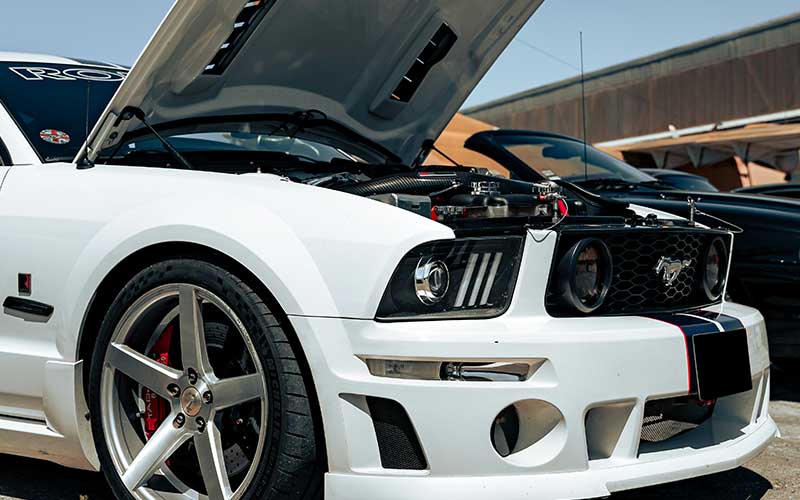
Since its introduction in 1964, the Ford Mustang has become one of the world’s most recognizable performance cars. One of the reasons for its enduring popularity is the wide range of engines Ford has offered over the decades. From economical four-cylinder engines to smooth six-cylinders and powerful V8s, the Mustang has been available in configurations designed for very different drivers and budgets.
The four-cylinder Mustang has often been associated with efficiency, but it has also demonstrated that a smaller engine can deliver serious performance. The first four-cylinder Mustang appeared during the 1970s, when the fuel crisis and changing emissions regulations forced American manufacturers to reconsider large-displacement engines. The 1974 Mustang II introduced a 2.3-liter four-cylinder engine that emphasized economy rather than outright performance.
However, Ford later showed that a four-cylinder Mustang could be much more exciting. The Mustang SVO, introduced in the 1980s, used a turbocharged 2.3-liter four-cylinder engine. With turbocharging, fuel injection, and advanced engineering for its time, the SVO provided strong performance while using considerably less fuel than a traditional V8. It became an important example of how forced induction could compensate for smaller engine displacement.
In the modern era, the four-cylinder Mustang became relevant again with the introduction of the 2.3-liter EcoBoost. Turbocharging allows this engine to produce substantial power and torque without the fuel consumption of a large V8. The EcoBoost has attracted buyers who want Mustang performance and styling but do not necessarily need the sound, weight, or fuel consumption of a V8.
Six-cylinder engines have also played an important role in Mustang history. Early Mustangs were available with inline-six engines, including the 170-, 200-, and later 250-cubic-inch units. These engines were generally designed for reliability, affordability, and everyday driving rather than maximum performance. Their relatively simple construction made them attractive to buyers who wanted the Mustang’s sporty appearance without the higher cost of a V8.
During the 1970s and 1980s, Ford continued offering six-cylinder engines as economical alternatives to larger engines. Later generations used V6 engines, including the 3.8-liter Essex V6 and the 4.0-liter V6 used in certain Mustangs during the 2000s. These engines provided a useful compromise between the economy of a four-cylinder and the performance of a V8.
The Mustang V6 became particularly popular because it offered respectable acceleration while generally costing less to operate than a V8-powered model. In later years, Ford’s 3.7-liter V6 became a particularly capable engine, producing significantly more power than earlier Mustang six-cylinders. Although modern turbocharged four-cylinder engines eventually replaced the V6 in Ford’s Mustang lineup, the six-cylinder Mustang remains an important part of the model’s history.
The V8, however, is the engine configuration most closely associated with the Mustang’s performance image. From the earliest Mustangs, Ford offered V8 power as an option for buyers seeking greater acceleration. Early engines included the 260- and 289-cubic-inch V8s, with the legendary 289 appearing in performance versions such as the Mustang GT and Shelby models.
During the muscle-car era, Mustang V8s grew larger and more powerful. Ford offered engines such as the 302, 351, and 390, while special high-performance models received even more serious powerplants. The 428 Cobra Jet, for example, became one of the most famous Mustang engines of the late 1960s.
The V8’s importance continued through subsequent generations. The 5.0-liter V8 became particularly famous during the 1980s and 1990s, when the Mustang developed a strong following among performance enthusiasts. The later 4.6-liter modular V8 brought modern overhead-cam technology to the Mustang, while the 5.0-liter Coyote V8 introduced for the 2011 model year established a new chapter in Mustang performance.
Modern Coyote V8s combine large-displacement performance with sophisticated technologies such as variable camshaft timing and advanced electronic engine management. In high-performance versions such as the Mustang GT and other specialized models, the V8 continues to represent the traditional Mustang philosophy of rear-wheel drive, strong acceleration, and an unmistakable exhaust note.
Ultimately, the different Mustang engine configurations demonstrate how the car has evolved with changing technology, regulations, and consumer preferences. Four-cylinder engines have offered efficiency and, in turbocharged form, impressive performance. Six-cylinder engines have provided a practical middle ground between economy and power. V8 engines have remained the heart of the Mustang’s performance heritage.
The appeal of the Mustang is that there has never been just one way to experience it. Whether powered by four, six, or eight cylinders, the Mustang has consistently offered buyers a combination of sporty design, rear-wheel-drive character, and accessible performance. That flexibility is a major reason the Mustang has remained an automotive icon for more than six decades.